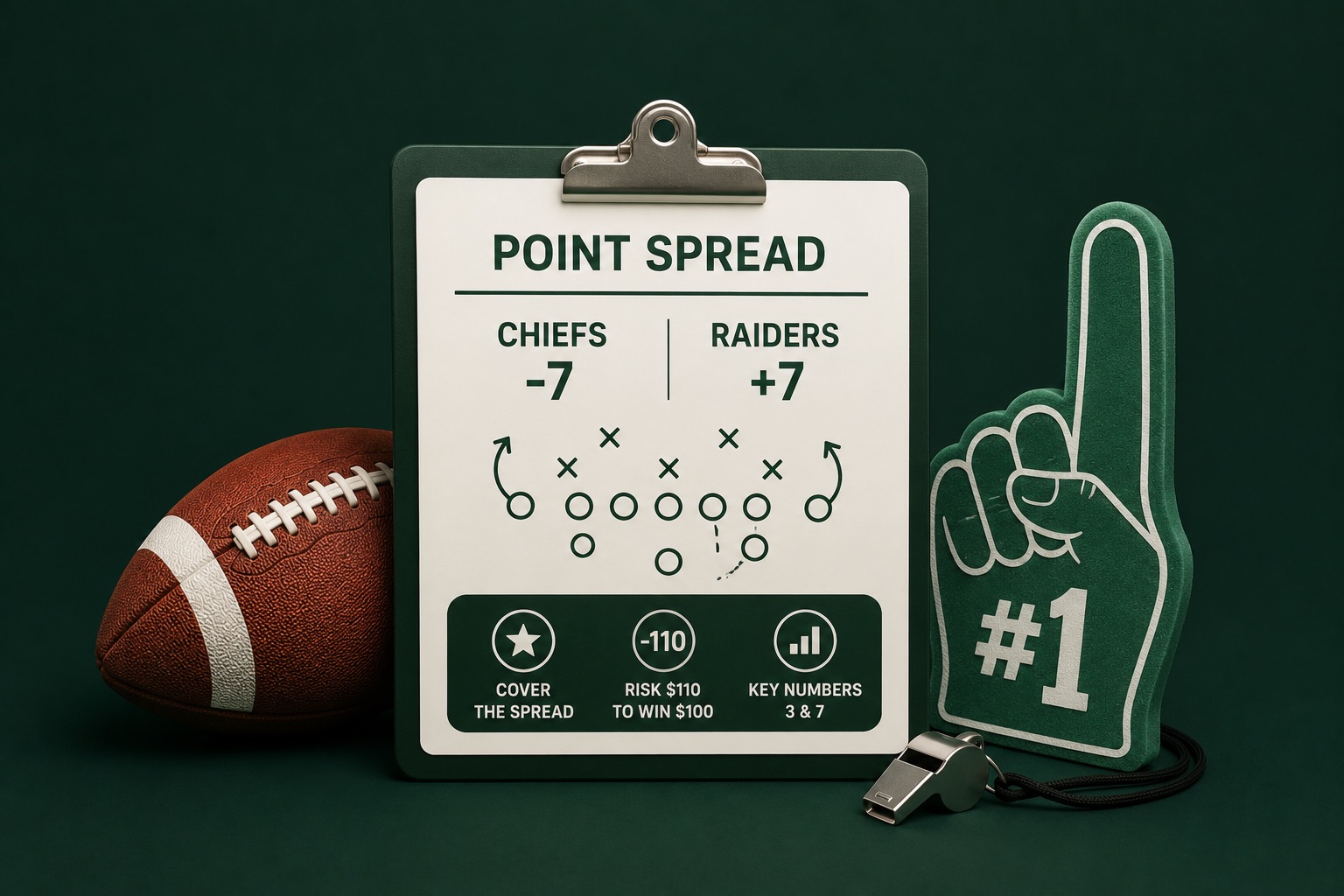
Key Points
- The spread equalizes mismatched teams by requiring favorites to win by a set margin.
- Both sides of a spread are usually priced at -110. You risk $110 to win $100.
- Covering the spread is not the same as winning the game.
- Key numbers (3, 7) matter enormously in NFL spread betting.
- Line shopping for even half a point can shift your long-term results significantly.
What is the Point Spread?
The point spread is a handicap applied to a game to level the playing field between mismatched teams. Instead of picking a winner, you're picking whether a team wins by more (or loses by less) than a certain number of points.
Example:
Kansas City Chiefs -7 vs. Las Vegas Raiders +7
The Chiefs must win by 8 or more points for Chiefs bettors to win. The Raiders bet wins if they win outright or lose by 6 or fewer. If the Chiefs win by exactly 7, it's a push and stakes are returned.
Reading the Spread
The negative number is the favorite (must win by more than that amount). The positive number is the underdog (can lose by up to that amount and still cover).
Both sides are typically priced at -110, meaning you risk $110 to win $100. That $10 difference is the vig (the sportsbook's commission).
How Spread Betting Differs from Moneyline
On the moneyline, you simply need your team to win. On the spread, you need them to win by a specific margin. This is why big favorites are far cheaper to bet on the spread (-110) than the moneyline (-400+).
| Bet Type | Chiefs Win by 6 | Chiefs Win by 8 | Chiefs Lose |
|---|---|---|---|
| Chiefs -7 (spread) | Loss | Win | Loss |
| Chiefs -250 (moneyline) | Win | Win | Loss |
Key Numbers in NFL Spread Betting
In the NFL, certain scoring margins happen far more often than others:
- 3 points: the most common margin (a field goal)
- 7 points: second most common (touchdown + extra point)
This is why -3, +3, -7, and +7 are extremely important spread values. A team favored by -3 that wins by exactly 3 results in a push. But -3.5 (three and a hook) requires a 4+ point win.
Shopping for spreads near these key numbers is one of the highest-value habits you can build.
How Lines Move
The opening line is set by the sportsbook. As bets come in, the line adjusts. Heavy public money on one side moves the line toward the other to balance exposure. Sharp money can also move lines significantly.
If you bet Chiefs -6.5 on Monday and the line moves to -7.5 by Sunday, you're in a good position. You got the better number.
Spread Betting Strategy
Shop for the best line. Getting +3.5 instead of +3 is the difference between winning and a push. Have accounts at multiple books.
Understand the key numbers. Spreads at -3 and -7 behave very differently from -3.5 and -7.5. Know what you're betting.
Track your ATS record. Your against-the-spread record tells you how well you're performing, separate from game outcomes.
Respect the closing line. If you can consistently get better numbers than where the line closes, you're doing something right.
Common Spread Betting Mistakes
- Betting the spread without understanding the vig (you need 52.4% to break even at -110)
- Ignoring line movement and betting at the worst available number
- Treating all half-points equally (a hook on a key number is worth far more than one on a non-key number)