Prediction Markets Explained: How Kalshi and Polymarket Work
By Ryan Cole · Published
Key Points
- An event contract pays $1 if the outcome happens and $0 if it doesn't.
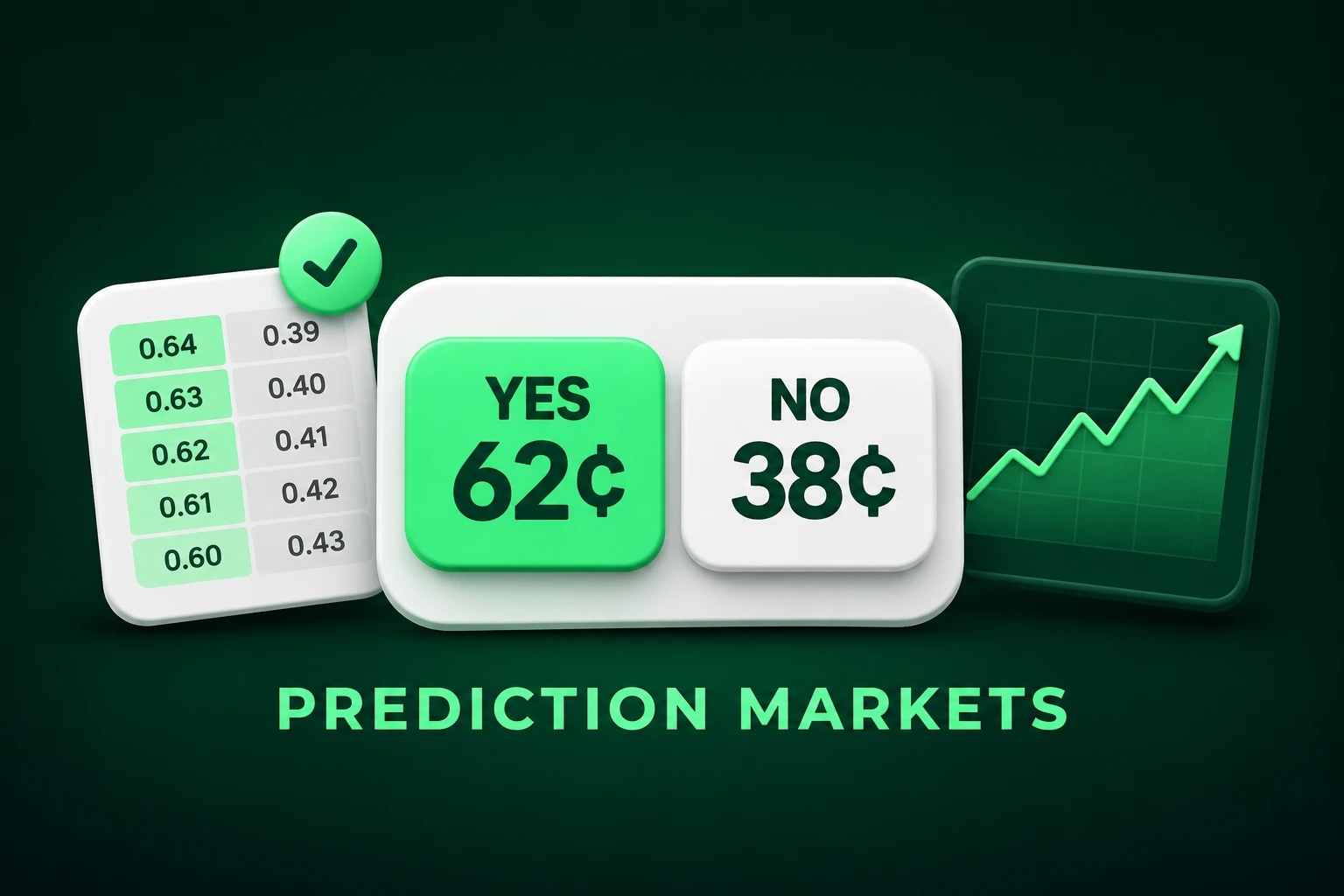
- The price in cents is the market's chance of it happening: 62¢ means about 62%.
- You trade against other people, not the house, and you can sell before the event ends.
- Kalshi's fee is highest on contracts priced near 50¢, at up to 1.75¢ per contract.
- Federal courts are split on whether states can ban sports contracts. Check your state's status before you sign up.
What Is a Prediction Market?
A prediction market is an exchange where people buy and sell event contracts on whether something will happen. Will the Chiefs win Sunday? Will the Fed cut rates in December? Will it snow in New York on Christmas?
Every contract has a simple payout. If the event happens, a Yes contract pays $1. If it doesn't, it pays $0. A No contract is the mirror image (see yes/no contracts).
The two names you'll hear most are Kalshi and Polymarket. Robinhood, Crypto.com, DraftKings and FanDuel now offer prediction markets too.
How the Price Works
Because a contract pays $1, its price in cents is the market's estimate of the chance it happens. A contract trading at 62¢ means traders as a group think there's about a 62% chance.
That's the same idea as implied probability at a sportsbook, just without the conversion step. You don't need to know what -165 means. The price already is the percentage.
Worked example
Say the Chiefs to beat the Broncos is trading at 62¢.
- You buy 100 Yes contracts: 100 x $0.62 = $62.
- The Chiefs win. Each contract pays $1, so you get $100 back.
- Your profit is $38, before fees.
- If the Broncos win, your contracts pay $0 and you lose the $62.
For comparison, a sportsbook might price the Chiefs at -165. A $62 bet at -165 wins $37.58. The two are close, which is common, because sharp traders move prices between markets when the gap gets big enough. That's the same force behind arbitrage.
You Can Sell Before the Game Ends
This is the biggest practical difference from a normal bet. A prediction market has an order book, so you can sell your contracts to another trader at any time.
If you bought the Chiefs at 62¢ and they go up 14 to 0 in the first quarter, the price might jump to 85¢. You could sell all 100 contracts for $85 and lock in a $23 profit without waiting for the final whistle. If they fall behind, you could sell at 40¢ and cut your loss to $22.
Sportsbooks offer cash out too, but the book sets that price. On an exchange, other traders set it.
Two prices show at any moment:
- Bid: the most someone will pay you for a contract right now.
- Ask: the lowest price someone will sell to you.
The gap between them is the bid-ask spread. In busy markets it's often 1¢. In quiet ones it can be 5¢ or more, which is a hidden cost every time you buy and sell.
What the Fees Cost
Sportsbooks build their cost into the odds, called the juice. Exchanges charge a separate fee per trade.
Kalshi's published formula for most markets is:
Fee = 0.07 x number of contracts x price x (1 - price), rounded up to the next cent.
The fee is biggest when the price is near 50¢ and shrinks toward the extremes:
| Price | Fee per 100 contracts |
|---|---|
| 10¢ | $0.63 |
| 30¢ | $1.47 |
| 50¢ | $1.75 |
| 62¢ | $1.65 |
| 90¢ | $0.63 |
In the Chiefs example, the $1.65 fee cuts your $38 profit to $36.35. Kalshi has changed its fee schedule more than once and some markets use different rates, so check its fee page before you trade. Polymarket's US exchange publishes its own fees, which also vary by market.
Prediction Market vs Sportsbook
| Prediction market | Sportsbook | |
|---|---|---|
| Who you bet against | Other traders | The sportsbook |
| How price is shown | Cents (equals % chance) | American odds like -110 |
| Cost | Fee per trade plus the spread | Juice built into the odds |
| Sell early | Yes, at the market price | Cash out, at the book's price |
| Federal regulator | CFTC | None. States regulate |
| Limits winning players | Generally no | Often yes |
| Markets offered | Sports, politics, economy, weather, culture | Sports and some novelty bets |
That "limits winning players" row matters to serious bettors. Sportsbooks often cut bet limits on accounts that win consistently. An exchange earns its fee whoever wins, so it doesn't have the same reason to limit you.
Kalshi vs Polymarket
Kalshi is a US exchange registered with the Commodity Futures Trading Commission (CFTC) as a designated contract market. You fund it in dollars from a bank account or card, like a brokerage. It started with economic and weather contracts and added elections and then sports.
Polymarket began as a crypto-based exchange. In 2022 it settled with the CFTC and blocked US users from its main site. It came back to the US by buying a CFTC-licensed exchange, and in November 2025 the CFTC approved an order letting it serve US customers through registered brokers. Its main international site remains separate, and reports say it has asked the CFTC to open that to Americans as well.
DraftKings Predictions and FanDuel Predicts launched in December 2025, using contracts listed on a CFTC-regulated exchange. Both have focused their sports contracts on states where their regular sportsbooks can't operate.
Are Prediction Markets Legal?
This is the part that's changing fastest. The details below are current as of November 15, 2026.
Non-sports contracts like the economy, weather and elections are offered nationwide under CFTC oversight.
Sports contracts are in a legal fight. Kalshi and the CFTC say these are federally regulated financial contracts, so state gambling laws don't apply. Many states say they're sports bets dressed up as swaps, and that offering them without a state license is illegal.
The federal appeals courts don't agree:
- The Third Circuit (covering New Jersey) sided with Kalshi.
- The Ninth Circuit (Nevada) and the Sixth Circuit (Ohio and Tennessee) ruled that states can apply their gambling laws.
- A Massachusetts state court barred Kalshi from offering sports contracts there without a license.
- The CFTC has sued several states to defend its claim to sole authority.
Petitions asking the Supreme Court to settle the question are pending. The Court hasn't agreed to hear the case yet. Kalshi's response in the New Jersey case is due December 7.
What this means for you: whether a prediction market offers sports contracts in your state can change with a single court ruling. The app will block you if you're in a state where it has stopped offering them. Many apps accept users from age 18, while sportsbooks require 21 in most states, which is one reason states and leagues are pushing back.
Is a Prediction Market Better Than a Sportsbook?
Sometimes the price is better. Because there's no built-in juice, a contract can be cheaper than the same bet at a sportsbook, especially when you back the favorite in a lopsided game, where the fee is a tiny share of the price. Long shots are the opposite: at 10¢, Kalshi's fee is about 6% of what you pay. Line shoppers should compare both.
But the core math hasn't changed. Most people who trade sports contracts lose money over time, the same as at a sportsbook. The fee and the spread take a cut, and you're trading against people who may know more than you do. Buying and selling all game long can also feel more like trading than betting, which makes it easy to lose track of how much you've spent.
Treat it like any other bet: set a budget first, track every trade with our bankroll management guide, and walk away when the budget is gone.
Quick Glossary
- Event contract: a contract that pays $1 if a stated outcome happens.
- Order book: the live list of buy and sell orders at each price.
- Bid-ask spread: the gap between the best bid and the best ask.
- Resolution: how and when the exchange decides the outcome, using a named source like the official box score.
- Liquidity: how much is available to trade near the current price. Low liquidity means wider spreads.
Want to check a price against sportsbook odds? Our odds converter turns any American line into a percentage you can compare with a contract price.